2 — Two Dollars
The artwork
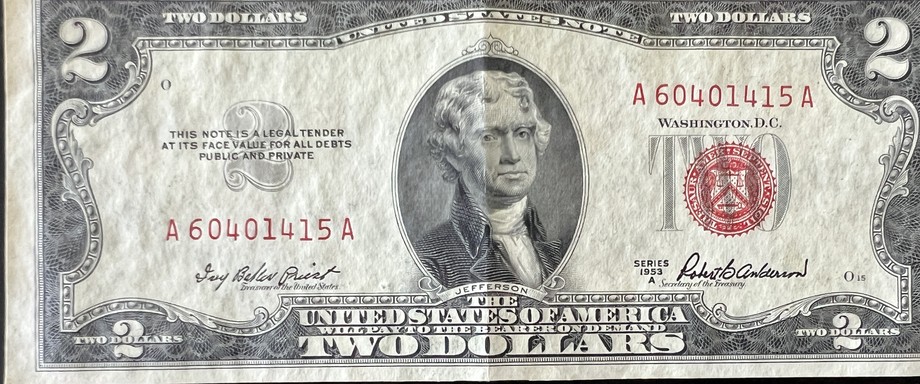
Front: Thomas Jefferson in three-quarter profile, engraved after the Gilbert Stuart portrait, set in an oval with the name JEFFERSON on a small tablet beneath. The legal tender clause sits at the left over a ghosted grey 2; at the right, the red Treasury seal over a large grey TWO, with WASHINGTON, D.C. above. Serials in red, twice, prefix and suffix A. Scrolled corner 2s and TWO DOLLARS along every edge.
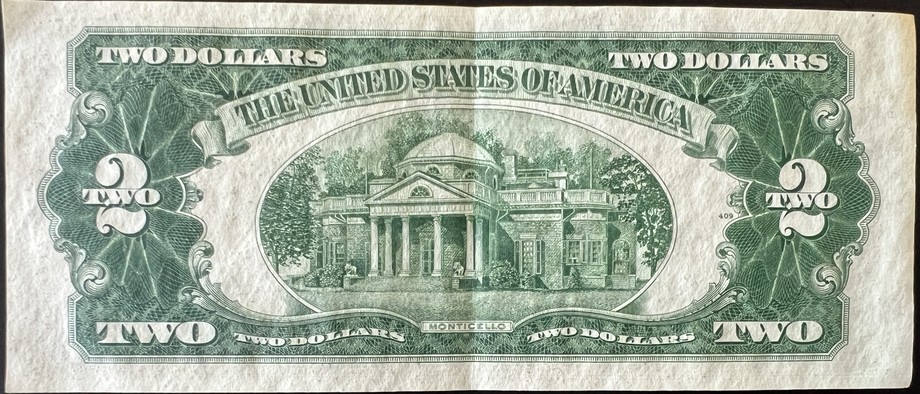
Back: Monticello, Jefferson's own house in Virginia, seen from the west front: the dome, the pedimented portico on its slim columns, wings and terraces running off to either side, trees crowding the lawn, and two small figures on the steps for scale. The name MONTICELLO sits on a tablet below. All in green, inside an oval, under a ribbon reading THE UNITED STATES OF AMERICA.Notes, with heavy lathework and TWO in each corner.
In circulation
A United States Note rather than a Federal Reserve Note, hence the red seal and the promise to pay the bearer on demand. The 1953 series ran through 1963A, after which the two-dollar denomination was dropped in 1966. It returned only in 1976, as a green-seal Federal Reserve Note with the Declaration of Independence on the back.
Details
- CurrencyDollar
- DenominationTwo Dollars
- Collectedon the United States journeys, 2012–2016
- IssuerUnited States of America — United States Note
- Series1953A
- SignatureIvy Baker Priest, Treasurer of the United States; Robert B. Anderson, Secretary of the Treasury
- PrinterBureau of Engraving and Printing
- Dimensions156 × 66 mm