₨100 — One Hundred Rupees
The artwork
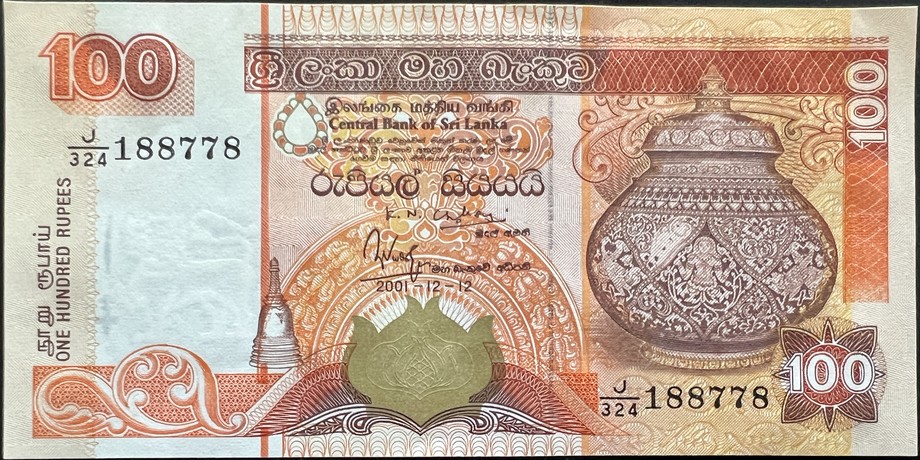
Front: Reading down: the bank's name in Sinhala across a dark ornamental band, then Tamil and English — "Central Bank of Sri Lanka" — with the value spelled out in Sinhala as රුපියල් සියයය. At right stands a lidded ceremonial pot, the punkalasa, engraved all over with beaded and foliate bands. Below the signatures a makara-style arch curves over a golden lotus, with a small white dagoba at the left. The left panel carries the value in Tamil and English, vertically.
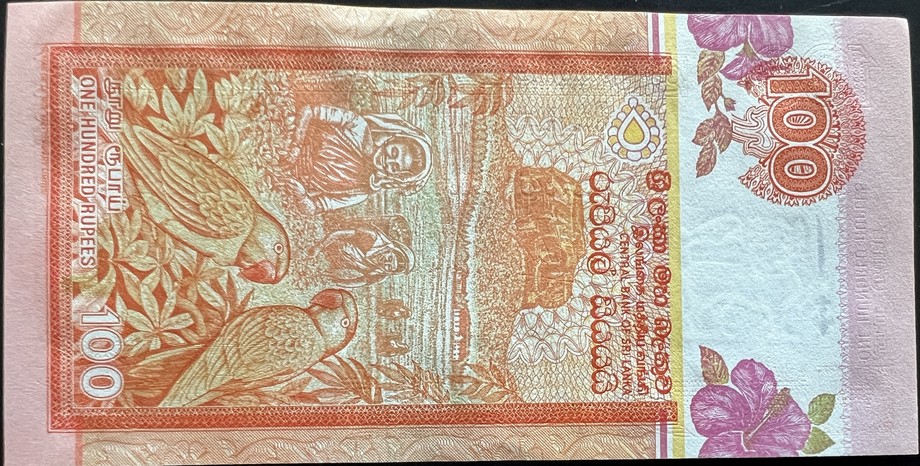
Back: An orange-and-olive scene of two parakeets among broad leaves and lotus blooms, the nearer bird perched low with its hooked red bill turned back. Behind them, cut into the rock face, stand tall robed figures in relief, weathered and shallow, with a carved slab to the right. The bank's name climbs vertically in Sinhala, Tamil and English, and the side panel is planted with magenta hibiscus and bougainvillea.
In circulation
The design belongs to Sri Lanka's long-running heritage-and-fauna family of notes, introduced in 1991 and reprinted with fresh dates for well over a decade — this one signed and dated 12 December 2001. It gave way to the 2010 "Development, Prosperity and Sri Lanka Dancers" series, whose 100 rupees took over from 2011.
Details
- IssuerCentral Bank of Sri Lanka (name printed in Sinhala, Tamil and English)
- CurrencyRupee (₨)
- DenominationOne Hundred Rupees
- Collectedon the Sri Lanka journey, 2005
- SeriesHeritage and fauna series, dated 2001-12-12
- SignatureTwo manuscript signatures beneath Sinhala titles
- SecurityEmbedded security thread and a lotus rosette device at centre front