10 — Ten Guilders
The artwork
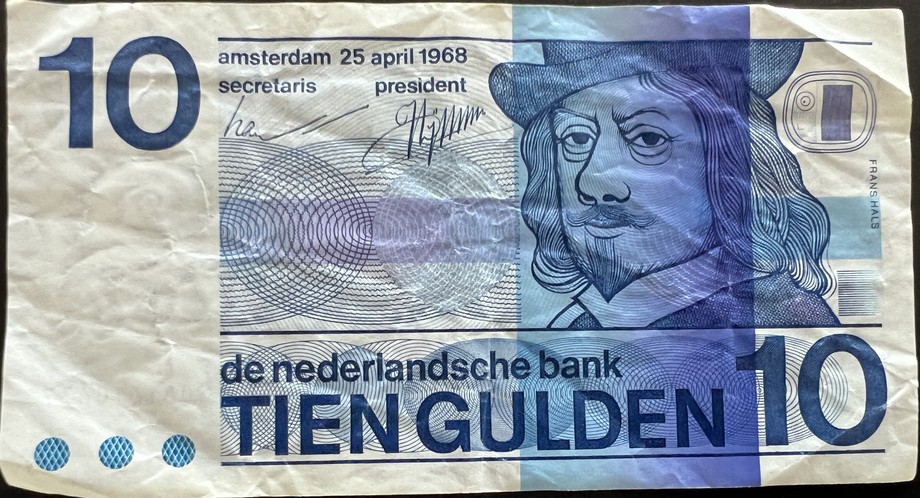
Front: Frans Hals, the Haarlem portraitist, in broad-brimmed hat and falling collar, his name set vertically in small caps at the right edge — a portrait built entirely from engraved concentric rings and wave-lines rather than conventional shading. To the left, the place and date of issue, "amsterdam 25 april 1968", above the signatures of the secretaris and the president, over a field of interlocking rosette guilloche. Below: de nederlandsche bank, TIEN GULDEN, with large 10s at the upper left and lower right.
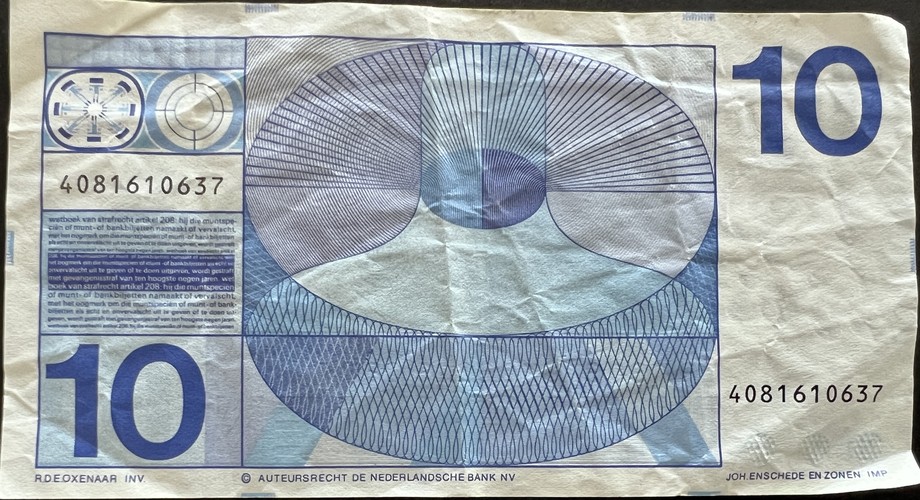
Back: No vignette at all — pure abstraction, unusual for its date. A fan of ruled lines sweeps into a great lobed arc with a solid ellipse at its centre, and beneath it a second broad arc filled with a woven lozenge net. Boxed panels at the left carry the ten-digit serial and a block of counterfeiting text from artikel 208 of the wetboek van strafrecht, set in diminishing type. Signed R.D.E. Oxenaar in the lower margin.
In circulation
The Frans Hals ten circulated as everyday Dutch money from the late 1960s through the 1980s, gradually giving way to the newer Oxenaar designs and finally to the 1997 kingfisher ten-guilder note. The guilder itself was retired when euro cash arrived in January 2002.
Details
- CurrencyGuilder
- DenominationTen Guilders
- IssuerDe Nederlandsche Bank
- SeriesDated Amsterdam, 25 April 1968 — Frans Hals type, designed by R.D.E. Oxenaar
- PrinterJoh. Enschedé en Zonen, Haarlem
- SignatureTwo: secretaris and president
- SecurityTen-digit serial printed twice on the back; microtext of penal code artikel 208 in the left-hand panel