E£5 — Five Pounds
The artwork
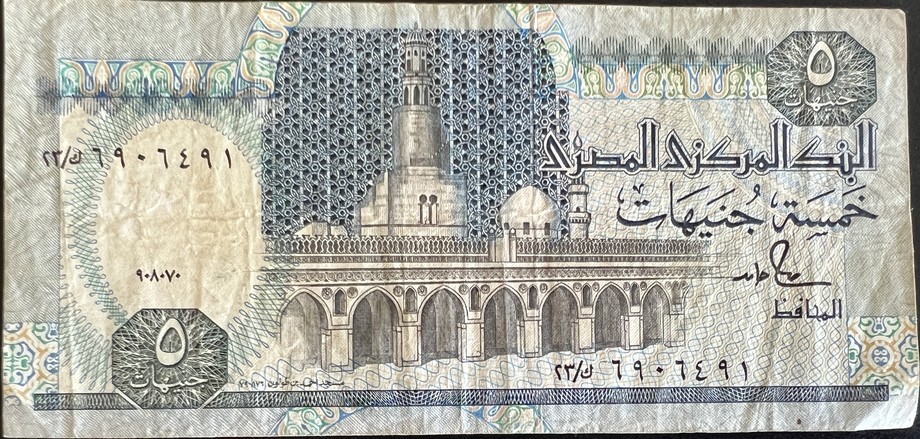
Front: The Mosque of Ahmad ibn Tulun in Cairo, captioned in Arabic beneath the frame with its ninth-century building dates — the spiral-ramped minaret rising against a lattice of pierced stucco, the arcaded sanctuary running the width of the note. To the right, "Central Bank of Egypt" and "five pounds" in Arabic script, over the Governor's signature. Octagonal 5 guilloches at either end, with tilework borders top and bottom.
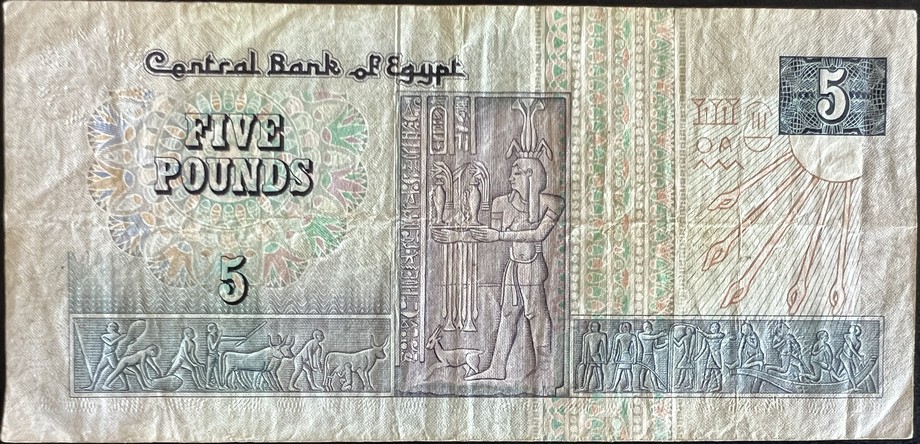
Back: English side: "Central Bank of Egypt" and FIVE POUNDS in shaded capitals, set over a rosette of coloured Pharaonic ornament. Centre, a relief of a king offering bound papyrus and lotus stems, hieroglyphs in the register behind him and a gazelle at his feet. Flanking friezes show ploughing with oxen and a line of men hauling a boat; at right, a sun disc trailing rayed hands.
In circulation
An issue of the Central Bank's Arabic-and-English five pounds, current through the 1970s and 1980s, when it was one of the everyday larger notes. Later five-pound designs kept the Ibn Tulun mosque on the face but reworked the reverse and tightened the security printing, and this older type was withdrawn from circulation.
Details
- IssuerCentral Bank of Egypt — البنك المركزي المصري
- CurrencyPound (E£)
- DenominationFive Pounds
- Collectedon the Egypt journeys, 1992–1993
- SeriesFive pounds, Mosque of Ahmad ibn Tulun type; Arabic face, English back
- SignatureSingle signature, the Governor (المحافظ)
- SecuritySerial number twice on the face in Arabic-Indic numerals with an Arabic fraction prefix (٢٣/ك)