50 — Fifty Kunas
The artwork
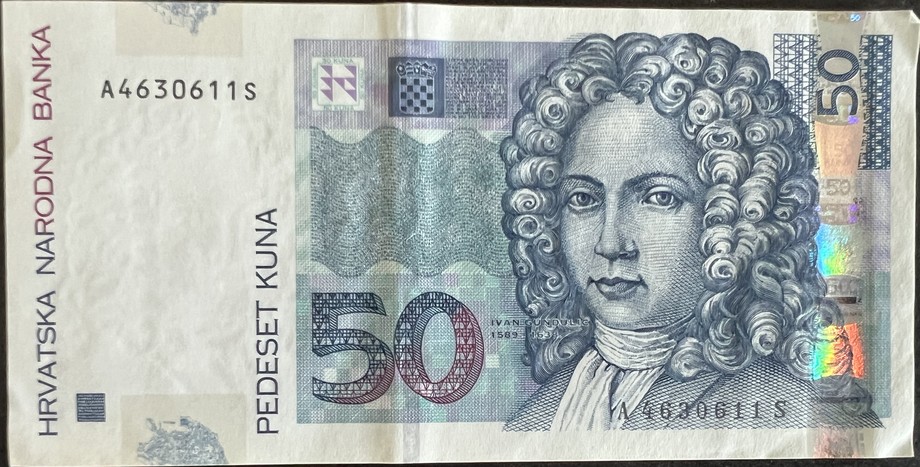
Front: Ivan Gundulić, the Dubrovnik poet, in a great cascading wig — captioned with his name and dates beneath the portrait. To the left, the Croatian chequy coat of arms and an ornamental panel carrying the figure 50, with PEDESET KUNA and HRVATSKA NARODNA BANKA set vertically up the margin. The serial number appears twice, prefixed A and suffixed S, in matching upper-left and lower-right positions.
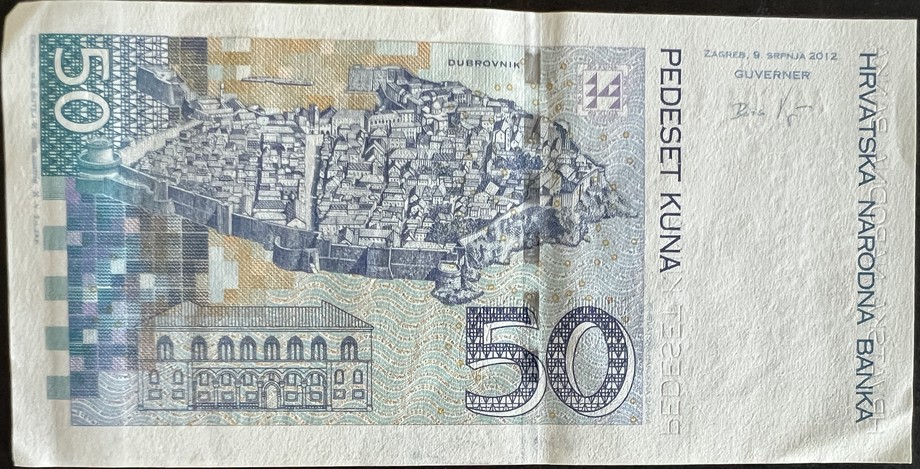
Back: A bird's-eye view of old Dubrovnik, the walled city on its promontory with the sea worked in fine wave engraving, labelled DUBROVNIK above the rooftops. Below sits the arcaded Sponza Palace, drawn in flat elevation. The right-hand panel carries the place and date of issue, Zagreb, 9 srpnja 2012, above the Governor's signature, with the denomination repeated large at lower right.
In circulation
The kuna series was introduced in 1994 and this 50-kuna design ran, in successive dated printings, until Croatia adopted the euro on 1 January 2023. Kuna notes remained legal tender through a short dual-circulation period in January 2023, after which euro banknotes replaced them entirely.
Details
- CurrencyKuna
- DenominationFifty Kunas
- Collectedon the Croatia journey, 2018
- IssuerHrvatska narodna banka (Croatian National Bank)
- SeriesDated Zagreb, 9 July 2012
- SignatureGovernor (single signature, reverse right panel)
- SecurityHolographic foil stripe at right of the face; see-through register formed by the arms device