20 — Twenty Kunas
The artwork
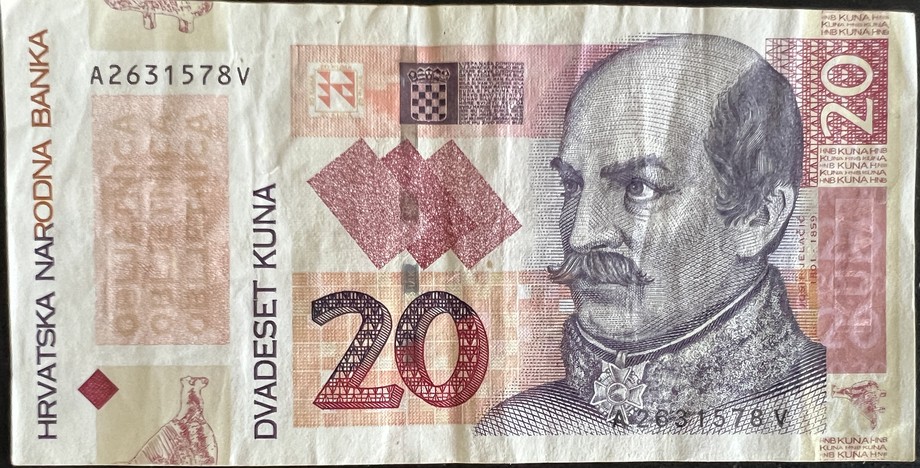
Front: Josip Jelačić, Ban of Croatia, in military dress with a star-shaped order at his breast; his dates, 1801–1859, run vertically beside him. To the left, the Croatian chequy shield and coat of arms, a large red diamond motif, and the value as a bold red 20. The issuer, HRVATSKA NARODNA BANKA, reads up the left edge, with DVADESET KUNA beside it; HNB KUNA microtext fills the right-hand panel. Serial A2631578V appears twice.
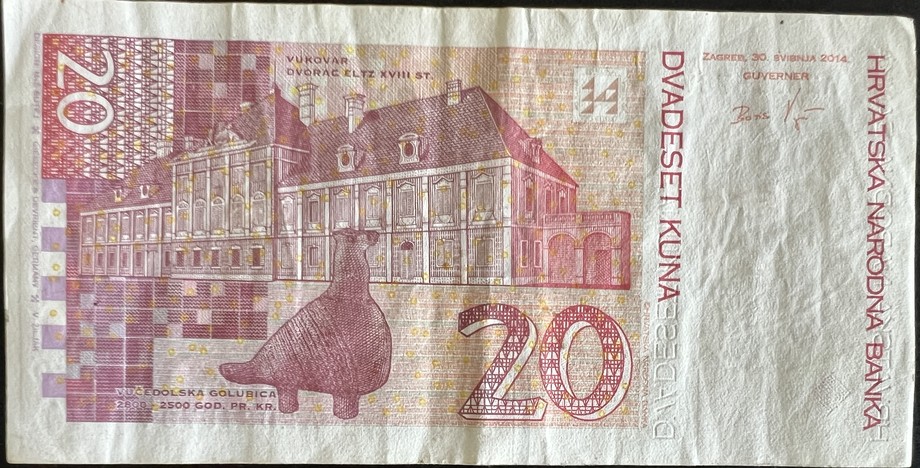
Back: The Eltz Manor at Vukovar, an eighteenth-century baroque palace stretched across the width of the note in rose and red, its long arcaded wing and dormered roof drawn in fine line engraving. In front of it stands the Vučedol dove, the ritual vessel of about 2800–2500 BC found nearby, captioned with its dates. Yellow security print scatters across the field; the value 20 sits at right, DVADESET KUNA up the panel.
In circulation
The kuna series designed in 1993 carried this 20 kuna through to the end of the currency. This particular printing is dated 30 May 2014 at Zagreb. Croatia adopted the euro on 1 January 2023, with kuna notes ceasing to be legal tender after a fortnight of dual circulation; the Croatian National Bank still exchanges them.
Details
- CurrencyKuna
- DenominationTwenty Kunas
- Collectedon the Croatia journey, 2018
- IssuerHrvatska narodna banka (Croatian National Bank)
- SeriesDated Zagreb, 30 svibnja 2014
- PrinterGiesecke & Devrient, Germany (credited in the left margin of the back)
- SignatureBoris Vujčić, Guverner
- Dimensions129 × 64 mm