10 — Ten Kunas
The artwork
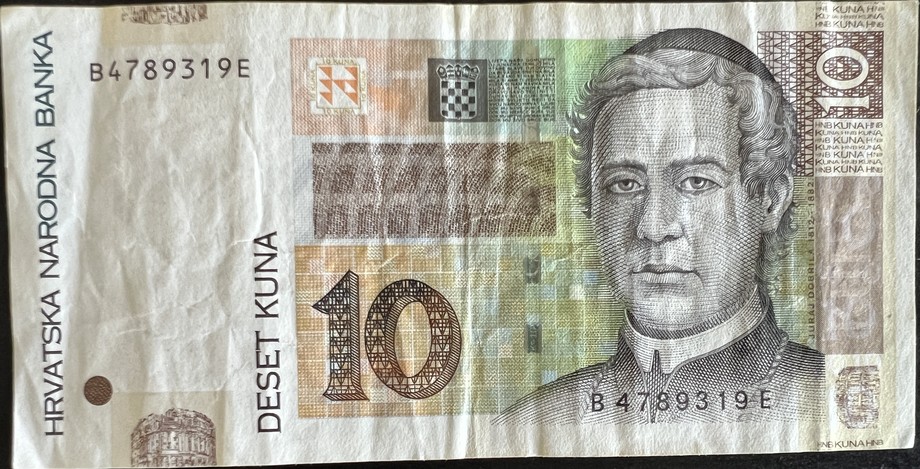
Front: Juraj Dobrila (1812–1882), the Istrian bishop and national awakener, engraved in three-quarter profile in clerical dress, his dates set vertically beside him. Left of centre sit the chequered Croatian coat of arms and a small see-through register panel; the field behind carries faint architectural motifs and a large orange-and-brown 10. "HRVATSKA NARODNA BANKA" runs up the left edge, with DESET KUNA beside the numeral. Serial B4789319E appears twice.
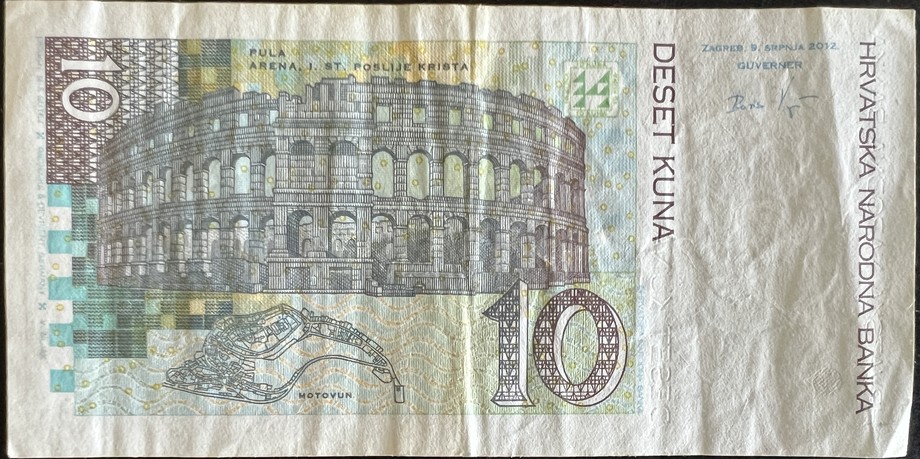
Back: The Arena at Pula, the Roman amphitheatre of the first century AD, drawn from the seaward side with its tiers of arches and the three rectangular towers intact — captioned "PULA, ARENA, I. ST. POSLIJE KRISTA". Below it, an outline ground plan of the hill town of Motovun with its ring of walls. Pale green and turquoise tones, a bold 10 at right, and the Zagreb dating and governor's signature on the white margin.
In circulation
The kuna returned as Croatia's currency in 1994, and this 10 kuna design ran with only detail changes through successive print dates, this one dated 9 July 2012. It stayed in use until the euro replaced the kuna on 1 January 2023, with kuna notes accepted alongside euros for a fortnight afterwards.
Details
- CurrencyKuna
- DenominationTen Kunas
- Collectedon the Croatia journey, 2018
- IssuerHrvatska narodna banka (Croatian National Bank)
- SeriesDated Zagreb, 9 July 2012 (9. srpnja 2012.)
- SignatureBoris Vujčić, Guverner
- Dimensions126 × 62 mm