50 — Fifty Francs
The artwork
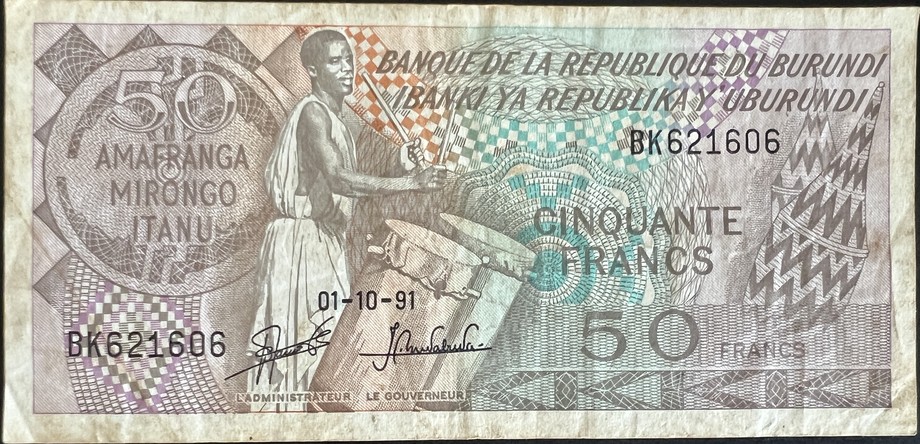
Front: A drummer in white wrap and bare shoulder, mid-stroke with both sticks raised over the tall Burundian karyenda drums — the ingoma tradition that gives the country its ceremonial voice. Behind him, orange and green chequered banners and, at the right edge, conical thatched roofs. The value reads twice: CINQUANTE FRANCS in French, AMAFRANGA MIRONGO ITANU in Kirundi, inside a large medallion at the left.
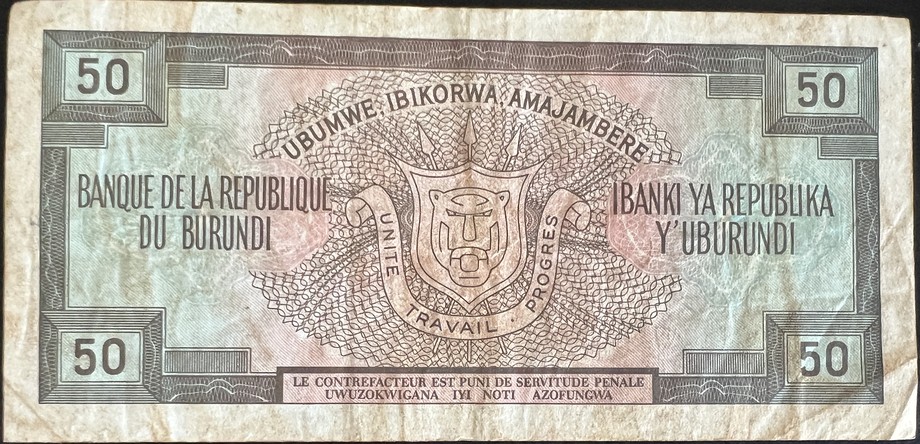
Back: The arms of Burundi fill the centre: a lion's mask on a shield, three crossed traditional spears behind it, and the motto UNITE TRAVAIL PROGRES on the ribbon below, with UBUMWE, IBIKORWA, AMAJAMBERE arched above in Kirundi. The bank's name is set twice, French to the left and Kirundi to the right, with a bilingual counterfeiting warning in the panel at the foot and 50 in each corner.
In circulation
A long-lived design of the Banque de la République du Burundi, issued through the 1970s to the early 1990s with the date changed on each printing — this one 1 October 1991. The 50-franc note was later superseded by coin and by the higher denominations that inflation made the everyday money.
Details
- IssuerBanque de la République du Burundi / Ibanki ya Republika y'Uburundi
- CurrencyFranc
- DenominationFifty Francs
- Collectedon the Burundi journey, 1992
- SeriesDated 01-10-91
- SignatureTwo: L'Administrateur and Le Gouverneur
- SecurityBilingual counterfeiting warning on the back: "Le contrefacteur est puni de servitude pénale / Uwuzokwigana iyi noti azofungwa"