K5 — Five Kyat
The artwork
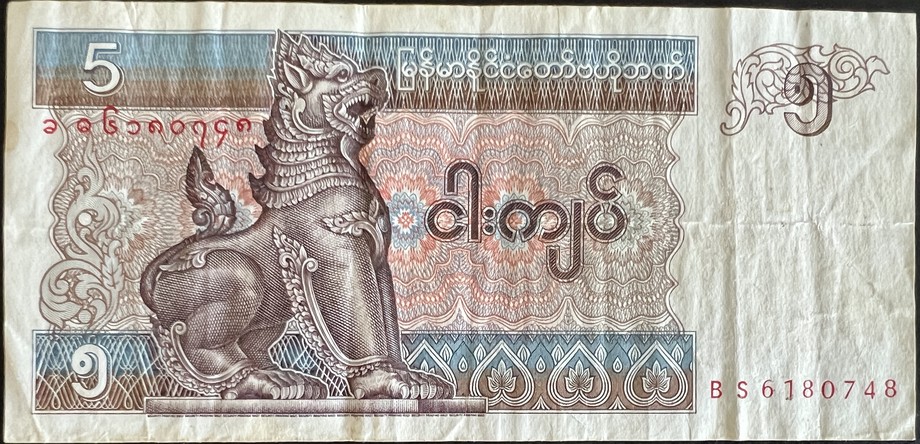
Front: A chinthe — the guardian lion that sits at the foot of every pagoda stairway in Burma — seated on its plinth, mane rendered in tight engraved scales, jaws open. Behind it, rosette guilloche in pink and slate. Burmese script across the top panel names the Central Bank of Myanmar; the value ငါးကျပ် (five kyats) stands to the right, with a western 5 and the Burmese numeral ၅ in the corners. Red serial, prefix BS, and a Burmese-numeral serial above left. A band of fine repeated microtext runs along the base.
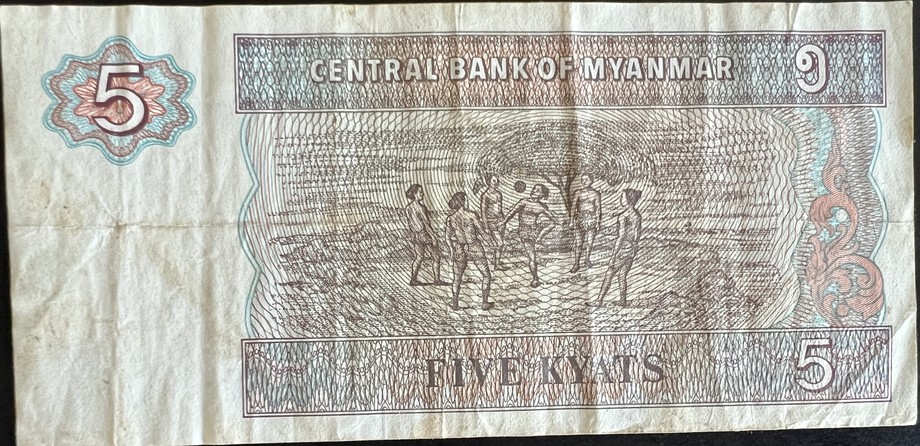
Back: A game of chinlone: six players ringed around a rattan ball, one lifting a knee to strike it, all worked in the same brown line engraving against a hatched riverbank and a spreading tree. The scene reads as a village clearing rather than an arena — chinlone is cooperative, not scored. CENTRAL BANK OF MYANMAR above in Roman capitals, FIVE KYATS below, with the Burmese ၅ and a western 5 flanking.
In circulation
Part of the undated Central Bank of Myanmar series introduced in the mid-1990s, replacing the earlier Union of Myanmar small change. Inflation soon stripped the 5 kyat of purchasing power, and it disappeared from everyday hands as the 1,000-, 5,000- and later 10,000-kyat notes took over. It remains legal tender in name only.
Details
- IssuerCentral Bank of Myanmar (မြန်မာနိုင်ငံတော်ဗဟိုဘဏ်)
- CurrencyKyat (K)
- DenominationFive Kyat
- Collectedon the Burma journey, 2001
- SeriesUndated Central Bank of Myanmar issue, mid-1990s
- WatermarkChinthe head
- SecurityLine of repeated microtext along the base of the plinth; red serial with two-letter Roman prefix and a matching Burmese-numeral serial